
The Herengracht is considered to be the most important canal in the city. In the 17th century, the richest merchants and the most influential regents and mayors of the city lived on this canal. Even today, an address on the Herengracht is seen as prestigeous and chique.
Herenmarkt
At the beginning of the Herengracht we find the Herenmarkt, a square that now serves as a children's playground. Behind the square stands the West India House, built in 1617. From 1624, the building served as the head office of the Dutch West India Company, a multinational which administered the Dutch colonies in North and South America. In the year 1625, a meeting took place in this building, in which it was decided to found the city of New Amsterdam. Which was later renamed to New York.
The three Hills
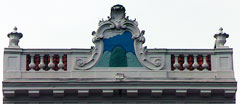
On the right hand side at nr 48 stands the merchant's house "the three hills" from 1612. The beautifully decorated gable was added in a restauration in 1768. The building is a national historical monument.
Oldest house
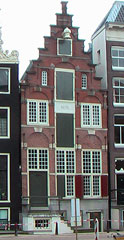
At the left side of the canal on nr. 81, we see the oldest residential house in Amsterdam, built in 1590 as a traditional merchant's house with a beautiful step gable.
Although the city was founded in 1275, most of the older houses date from after 1600. Initially, most Amsterdammers built wooden houses. In the Middle ages there were 3 big city fires in which almost all the houses in the city were destroyed. The last big fire took place in 1597. After tis fire, the city council put a ban on the construction of wooden houses. Only brick and stone houses were allowed to be built.
Love story
The house on nr. 132 at the right side of the canal was destroyed on New Year's eve of 2008 by a fire that was caused by a maroon. The house is a national historic monument which will eventually be rebuilt. In the 17th century this house was the stage of a dramatic love story between the rich merchant's daughter Elisabeth de Flines and her father's servant. Father Louis de Flines used all his power and influence to prevent a marriage between his daughter and the servant. Elisabeth eloped with her lover and the couple had a baby. But father Louis had her tracked down and brought back, and then he forced her to marry a gunsmith.
Bartolotti house

At nr 172 on the right side of the canal stands one of the most beautiful merchant's houses in Amsterdam. It was designed by municipal architect Hendrick de Keyser and built in 1617 for merchant Willem van den Heuvel, with money he inherited from his uncle Giovanni Bartolotti. After building the house, van den Heuvel had his name changed to Guillermo Bartolotti. He made his fortune as a silk merchant and banker. In his time he was one of the richest men in Amsterdam.
The Hoxton hotel
On the left side at nr. 255 there is The Hoxton hotel. A hotel created in one of the most beautiful locations in the Old City centre. Established in historical 17th and 19th century townhouses, this is a boutique hotel of excellent reputation.
Cromhout houses
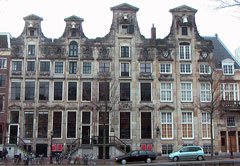
On the right side at the numbers. 364-370 you find the four Cromhout houses. They were designed in classicistical style by the famous architect Philip Vingboons, and built in 1660 for the extremely rich merchant Jacob Cromhout. This Cromhout and his wife Margaretha Wuytiers moved into the biggest of the four houses at nr 366, the other 3 houses were rented out. Behind the houses is a garden with biblical themes.
Restaurant Zuid Zeeland
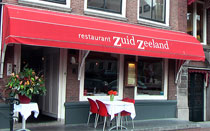
At nr 413 on the left side is a well known restaurant with a French cuisine and an intimate design. The guest book of Zuid Zeeland carries the names of famous people like Al Gore and Matt Damon.