
The Westerkerk building
was designed by city stonemason Hendrick de Keyser (1565-1621) and built between 1620 and 1631, commissioned by the Amsterdam city council. While it wasn't the first church in Amsterdam, it was the largest built as a Protestant church. Built in the Dutch Renaissance style, the church is shaped like a double cross.
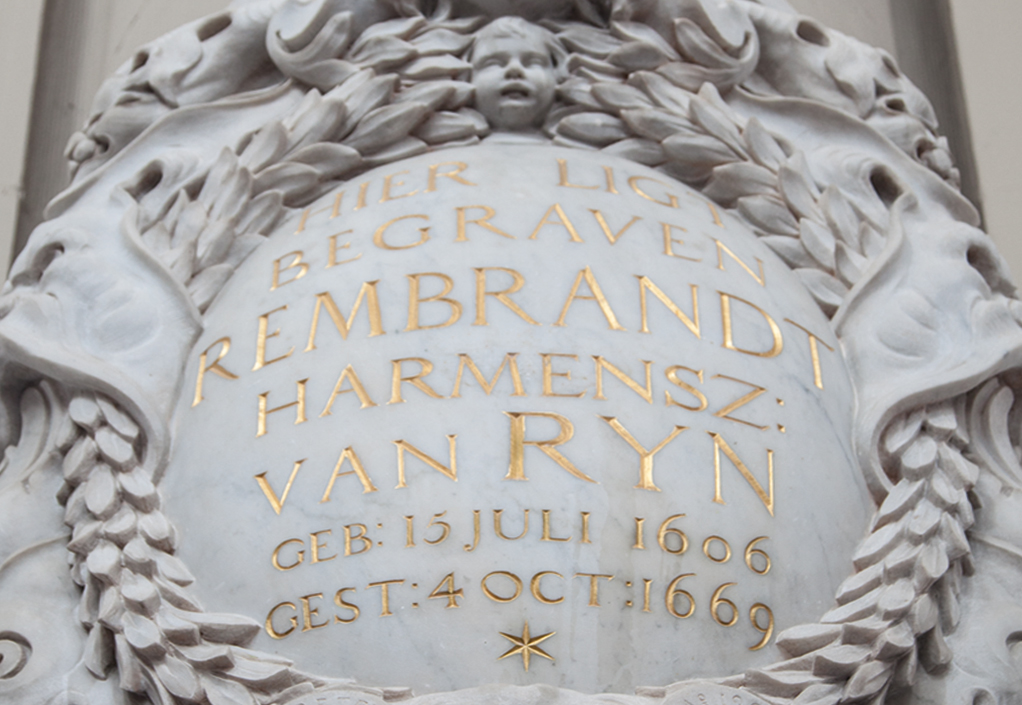
Rembrandt van Rijn Memorial Stone.
The famous painter Rembrandt van Rijn (1606-1669) lived near the Westerkerk on Rozengracht towards the end of his life. He was buried in the Westerkerk on October 8, 1669. The exact location is no longer known. A plaque in his memory hangs on the north wall.
Pulpit, Lectern, and Candlestick
The 17th- century pulpit—also called the pulpit—is located literally in the center of the church building: where the two Greek crosses that define the church's architectural structure meet. This location symbolizes the role that reading the Bible and preaching the Christian faith have played from this spot throughout the centuries.
In front of the pulpit, on an 18th - century ball-leg table, stands a historic copper lectern. It is mounted on a gleaming globe, created by sculptor Hans 't Mannetje. Just as this lectern expresses that the church has had a Word for the world throughout the centuries, so too does the obelisk-shaped candlestick, also created by 't Mannetje, carry the Paschal candle, symbolizing the light of Christ present in our world.
Burning Bush
The "Burning Bush" was also designed by sculptor Hans 't Mannetje. The artwork, which also serves as a place of reflection, represents what connects Christian, Jewish, and Islamic traditions: a universal human longing to experience the ineffable, the closeness of the Eternal. The ancient story of the Eternal's appearance to Moses in a flaming bush in the desert (Bible/Torah: Exodus 3, Quran: Surah 20) inspired the artist to create this work.
Mayor's Gate:
On the Westermarkt side of the church, the Mayor's Gate can still be seen. Former mayors could enter the church directly through this entrance and take a seat in their own pew (the Mayor's Bench), the largest of the iconic "gentlemen's pews" built around a series of columns. These are remnants of a time when there were no chairs in the church, but the city's magistrates and wealthy merchants still wanted comfortable seating.
The twelve copper chandeliers, adorned on three sides with the Amsterdam city coat of arms, are replicas of historic 17th- century chandeliers. After a period in which people switched to gas and later to electricity, chandeliers have again complemented the artificial lighting in the barrel vault since the late 20th century .
Organs
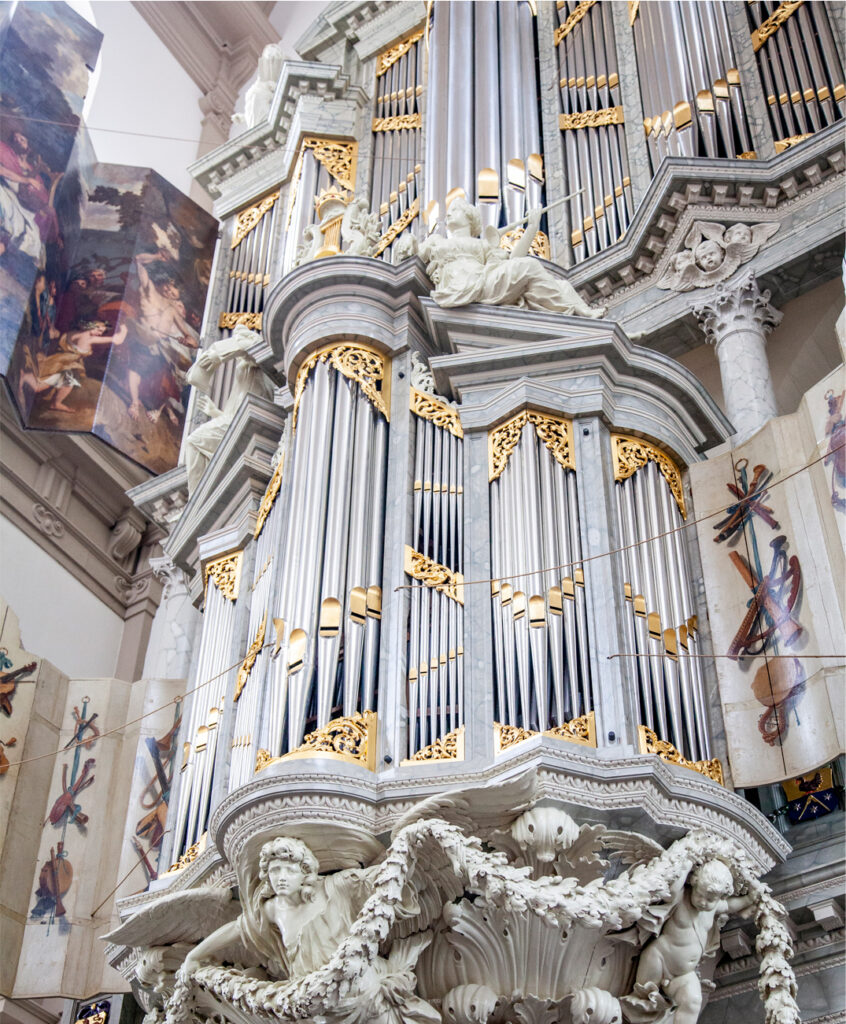
Duyschot Organ
When the Westerkerk was inaugurated on Whit Monday 1631, there was no organ yet. In 1681, the city council decided to commission organ builder Roelof Barentszn. Duyschot to build one. The paintings on the organ shutters are by Gerard de Lairesse. They depict biblical scenes: King David and the return of the ark to Jerusalem, and the visit of the Queen of Sheba to King Solomon. Carvings adorn the organ case: angels at the bottom, the singing and playing of the instruments, and three figures representing faith, hope, and love. The Duyschot organ has undergone several restorations over its 350-year history, the last in 2019.
Choir Organ
The second, smaller organ in the Westerkerk is the Choir Organ or “Ds. HA Visser Organ”, named after Rev. Henny A. Visser (1911-2006), who was minister of the Westerkerk from 1949 to 1977 and introduced cantata services in the Westerkerk. DA Flentrop built this organ in 1963 at the request of the Westerkerk in the Neo-Baroque style.
Main Duyschot organ

There was no organ when the Westerkerk was consecrated on Pentecost Sunday, June 8, 1631, in accordance with Calvinistic belief at that time instrumental music in the church was considered profane. It took many years of deliberation until an organ was finally allowed. At first there was still talk of moving the small organ (koororgel) used in the Nieuwe Kerk or the Oude Kerk, but the pipes of the Oude Kerk choir organ were finally moved to the Zuiderkerk. In 1681 the Westerkerk decided to commission the organ builder Roelof Barentszn Duyschot for the construction of a new organ. Roelof Barentszn Duyschot died before the organ was completed. His son finished the commission in 1686. Later, in 1727, the console was enlarged with a third manuel by Christiaan Vater, who learned his profession through Arp Schnitger.
Many alterations were done on the organ in the course of time. In the 19th century in 1895 a rebuild of the inside of the organ took place by Daniel Gerard Steenkuyl. Many of the old pipes and the wind chests were re-used. In 1939, the keyboard was equipped with electric tracker action and a swell work was added. It was not what this organ was intended to be in sound and action. The organ was almost doubled in size, but was also too big for its case.
So between 1989 and 1992 the organ was reconstructed by Flentrop organ builders in Zaandam to its former mechanical action, again more or less like Christiaan Vater made it in 1727. Today the bovenwerk (Oberwerk, located in the top of the organ case) is still almost complete, with stops by Vater. An exception is the baarpyp, which is made by Steenkuyl in 1896 and the Dulciaan which is made by Flentrop in 1992. The front pipes were made in 1842 by Hermanus Knipscheer. The situation after 1992 was that less than half of the pipes are historic and re-used in the hoofdwerk (great organ) and the Rugwerk (choir organ). The manuals and stop triggers beside this mechanical baroque organ are located in the main case behind this rugwerk. For this kind of baroque organs, it is characteristic that many of the stops, mainly the principals, are doubled in the trebles. This was set up to create more power in leading the congregation in their psalm singing. For complex organ works one or even two stop assistants are necessary for triggering the stops. During the restoration of the inside of the church between 2018 and 2020, the inside of the organ was taken to Zaandam at Flentrop Orgelbouw for cleaning and partly revoicing the sound. In the spring of 2020 it was returned to the church. On 18 April the new organist Evan Bogerd performed the commissioning concert on the internet; the church was closed to visitors because of the coronavirus pandemic.
From April till the end of October, there is a free weekly lunchtime concert on Fridays or Saturdays at 1pm. In August there are free concerts almost every day for a week 'Geen dag zonder Bach' ('Not a day without Bach') and the Grachten (Canal) festival. A voluntary donation is asked at the end of the concert upon leaving the church. Music by Johann Sebastian Bach (1685–1750) is performed almost weekly at the services of divine worship on Sundays.
Western Tower
The Westertoren (completed in 1638) is the tallest church tower in Amsterdam, at 85 meters tall (87 meters including the rooster). It is one of the capital's most famous landmarks. The Westertoren is by far the most sung about and written about church tower in Amsterdam, nicknamed "the Long John," "the Old Wester," or "the Pearl of the Jordaan."
The tower was designed by city architect Hendrick de Keyser (1565-1621), who died a year after construction began. The church and tower were then completed under the direction of his son, city stonemason and architect Pieter de Keyser, and city mason Cornelis Dankersz de Rij.
Normally, the tower can be climbed up to the first balcony. Unfortunately, this will not be possible in the coming years due to restoration work.
However, carillonneur Boudewijn Zwart usually gives a carillon concert on Tuesday afternoons from 12:00 to 1:00 PM, which can be heard around the Westertoren. For more information, see bellmoods.

To dig
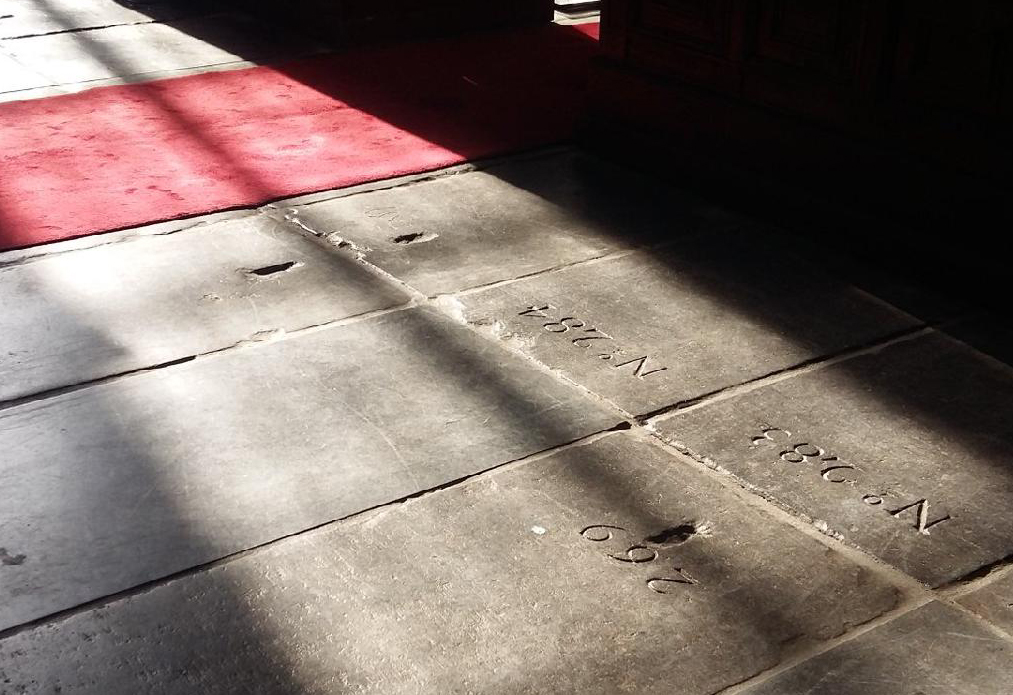
What do painters Rembrandt van Rijn, Govert Flinck, cartographer Joan Blaeu, and gin distiller Lucas Bols have in common? They are buried in the Westerkerk. Since the early seventeenth century, hundreds of Amsterdammers have found their final resting place here. The gravestones in the Westerkerk bear silent witness to this.
For some time now, several volunteers from the Westerkerk have been researching who is buried in the Westerkerk, including the origins of the people buried there, their occupations, and how they lived.
The interactive database will bring the history of Amsterdammers from the past to life.
Click below for the map!
http://www.westergraven.nl /